1. The integration of housing engineering has a high degree of standardization, shortened construction period, and greatly reduced costs: the standardized modular design of temporary facilities has achieved large-scale industrial production of temporary construction, improved the pre engineering of buildings, and made temporary construction components of different shapes, materials, and production methods have certain universality. At the same time, the pre engineering of temporary facilities integrates material processing and installation, greatly reducing construction and installation costs; And it has accelerated the construction speed, shortening the construction period by more than 60%, thereby speeding up the capital turnover of the construction unit and enabling the construction site to start earlier.
2. Integrated houses can meet the requirements of height and super span: light steel structure materials have uniform organization, high strength, and high elastic modulus, and their density to strength ratio is much smaller than that of concrete and bricks. Under the same stress conditions, the self weight of light steel structures is small, making it possible to make light steel integrated houses with larger spans and higher heights.
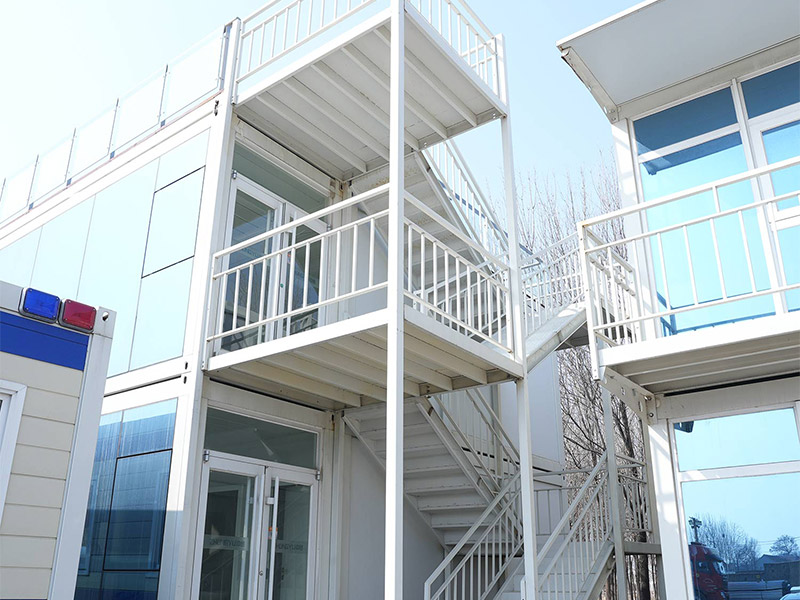
3. Integrating house design with functional integration, making temporary facilities more functional: In temporary facilities, light steel structure becomes an important factor in image composition, and the form, components, and nodes of the structure largely affect and constrain the image of the temporary building. The design and function of architecture and structure can only be integrated to make the building more functional, so that subsequent design processes can proceed and create temporary facilities that integrate technology and art.


